
SAE AIR4069 PDF
Original price was: $175.00.$99.75Current price is: $99.75.
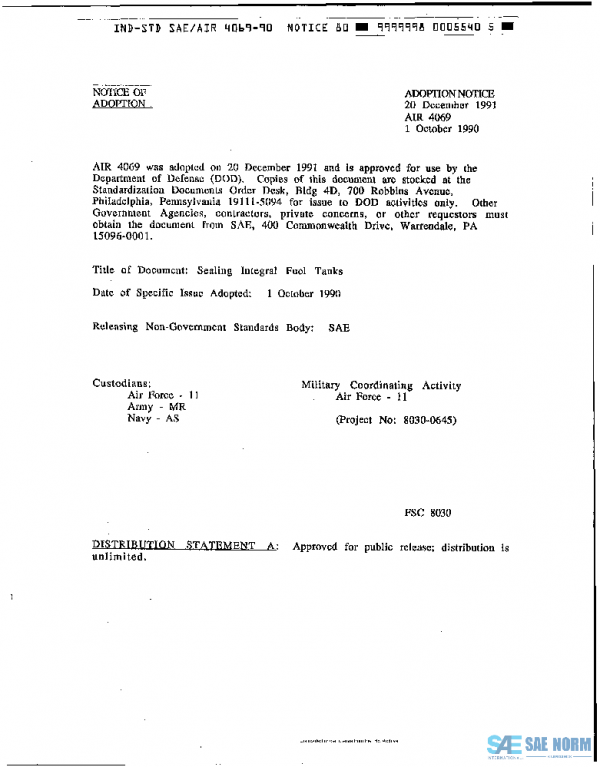
SEALING INTEGRAL FUEL TANKS
Description
This Aerospace Information Report (AIR) presents preferred practices for sealing and repairing integral fuel tanks. It addresses several basic fuel tank designs as they are currently found in practice and discusses the most practical and conservative methods for producing a reliable, sealed system. Design preferences for optimum sealing are not within the scope of this document. Such discussions can be found in the Air Force sponsored handbook entitled Aircraft Integral Fuel Tank Design Handbook, AFWAL-TR-87-3078.
The basic goal in sealing an integral fuel tank is to produce a system that is leak-free for the long term under the environmental and operational conditions expected. Factors that can influence the outcome are:
a
How well the basic design lends itself to good sealing (accessibility; minimal movement; other design factors)
b
The choice of sealant; where it is applied; how it is applied
c
How well the substrate surface is prepared
d
Whether the thickness and contour of sealant fillets and coatings are optimum for the configuration and flight dynamics
e
The degree of resistance of the sealant to the fluid and thermal environment
f
The degree of “insurance” employed (adhesion promoters, top coats over sealants, etc.)
Sealing the tank is a prime consideration. Sealant fillets inside the tanks are considered to be primary seals. Of nearly equal importance is corrosion control. Sealants are used for both, but the purpose of use should never be confused. It is generally accepted, for example, that a major purpose of faying-surface sealing is corrosion control. The faying-surface seal is not considered to be a primary seal except in adhesively sealed systems. It indeed plays an extremely important role as a secondary seal. It limits the length of a leak path and is a permanent, stable, and essentially dislodgeable, protected seal sandwiched between two surfaces. Extensive use is highly recommended.
Sealing philosophies differ within industry and government. There is, however, far more agreement than dispute. Where serious differences in philosophy prevail, they will be noted. If a particular approach appears to be clearly more protective, keeping time and costs in mind, it will be identified as a preferred method.
This document is a distillation of the considered opinions of a broad cross-section of experts in the private and public sector. The user is free to consider the options and plot his individual course from, perhaps, a somewhat more informed position.
History
| AIR4069D | 2022-07-26 | Latest | Revised |
| AIR4069C | 2016-11-23 | Historical | Revised |
| AIR4069B | 2010-01-14 | Historical | Revised |
| AIR4069A | 1998-05-01 | Historical | Revised |
| AIR4069 | 1990-10-01 | Historical | Issued |
| ISSUING COMMITTEE | AMS G9 Aerospace Sealing Committee |
|---|---|
| DATE | 1990-10-01 |
| DOI | |
| ISCURRENT | |
| PAGE | 88 |
| PUBLISHER | SAE International |
| REVISED | ISSUED |
Please select a variation to view its pdf.
Reviews
There are no reviews yet.