
SAE J1637_199302 PDF
Original price was: $115.00.$65.55Current price is: $65.55.
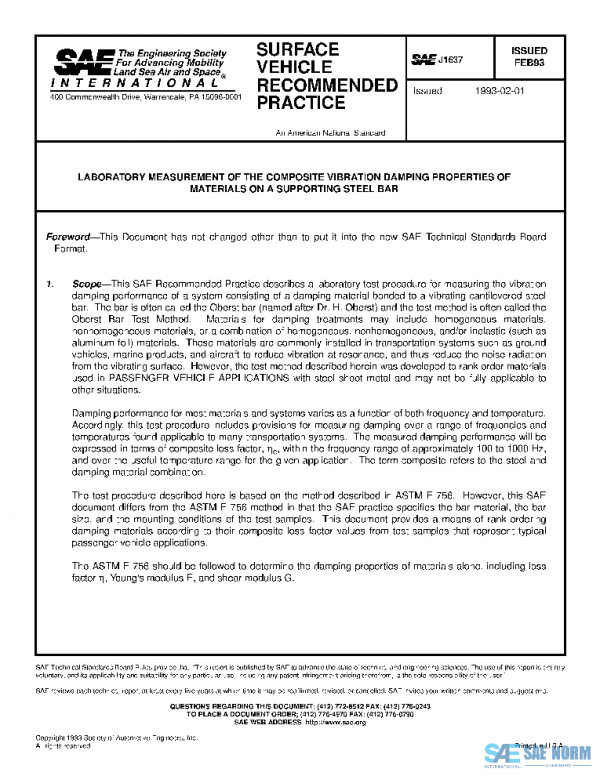
LABORATORY MEASUREMENT OF THE COMPOSITE VIBRATION DAMPING PROPERTIES OF MATERIALS ON A SUPPORTING STEEL BAR
Description
This SAE Recommended Practice describes a laboratory test procedure for measuring the vibration damping performance of a system consisting of a damping material bonded to a vibrating cantilevered steel bar. The bar is often called the Oberst bar (named after Dr. H. Oberst) and the test method is often called the Oberst Bar Test Method. Materials for damping treatments may include homogeneous materials, nonhomogeneous materials, or a combination of homogeneous, nonhomogeneous, and/or inelastic (such as aluminum foil) materials. These materials are commonly installed in transportation systems such as ground vehicles, marine products, and aircraft to reduce vibration at resonance, and thus reduce the noise radiation from the vibrating surface. However, the test method described herein was developed to rank order materials used in PASSENGER VEHICLE APPLICATIONS with steel sheet metal and may not be fully applicable to other situations.
Damping performance for most materials and systems varies as a function of both frequency and temperature. Accordingly, this test procedure includes provisions for measuring damping over a range of frequencies and temperatures found applicable to many transportation systems. The measured damping performance will be expressed in terms of composite loss factor, ηc, within the frequency range of approximately 100 to 1000 Hz, and over the useful temperature range for the given application. The term composite refers to the steel and damping material combination.
The test procedure described here is based on the method described in ASTM E 756. However, this SAE document differs from the ASTM E 756 method in that the SAE practice specifies the bar material, the bar size, and the mounting conditions of the test samples. This document provides a means of rank ordering damping materials according to their composite loss factor values from test samples that represent typical passenger vehicle applications.
The ASTM E 756 should be followed to determine the damping properties of materials alone, including loss factor η, Young’s modulus E, and shear modulus G.
History
| J1637_202202 | 2022-02-17 | Latest | Revised |
| J1637_201306 | 2013-06-18 | Historical | Reaffirmed |
| J1637_200708 | 2007-08-13 | Historical | Revised |
| J1637_199302 | 1993-02-01 | Historical | Issued |
| ISSUING COMMITTEE | Acoustical Materials Committee |
|---|---|
| DATE | 1993-02-01 |
| DOI | |
| ISCURRENT | |
| PAGE | 16 |
| PUBLISHER | SAE International |
| REVISED | ISSUED |
Please select a variation to view its pdf.
Reviews
There are no reviews yet.