
SAE J171_197009 PDF
Original price was: $75.00.$42.75Current price is: $42.75.
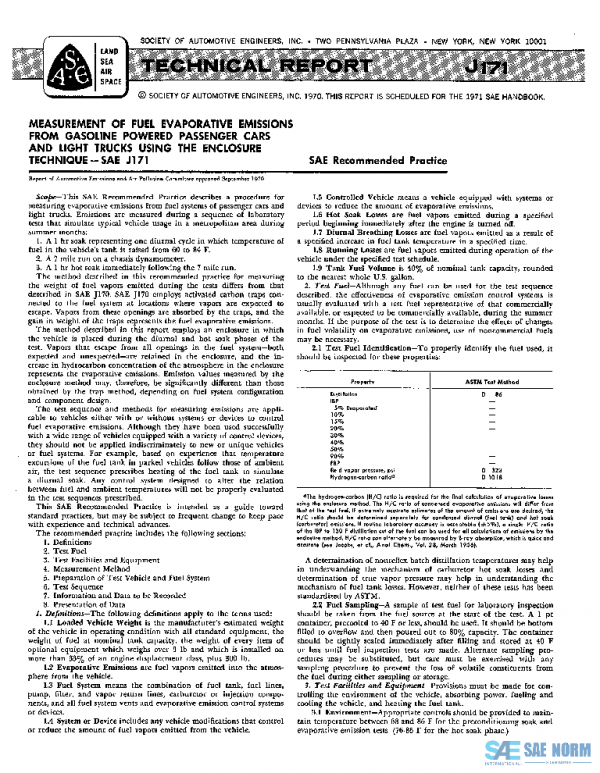
MEASUREMENT OF FUEL EVAPORATIVE EMISSIONS FROM GASOLINE POWERED PASSENGER CARS AND LIGHT TRUCKS USING THE ENCLOSURE TECHNIQUE
Description
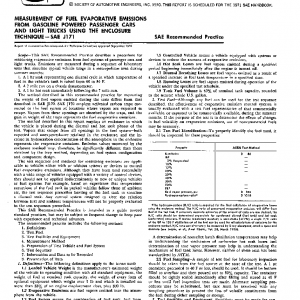
This SAE Recommended Practice describes a procedure for measuring evaporative emissions from fuel systems of passenger cars and light trucks. Emissions are measured during a sequence of laboratory tests that simulate typical vehicle usage in a metropolitan area during summer months:
1
A 1 hr soak representing one diurnal cycle in which temperature of fuel in the vehicle’s tank is raised from 60 to 84 F.
2
A 7 mile run on a chassis dynamometer.
3
A 1 hr hot soak immediately following the 7 mile run.
The method described in this recommended practice for measuring the weight of fuel vapors emitted during the tests differs from that described in SAE J170. SAE J170 employs activated carbon traps connected to the fuel system at locations where vapors are expected to escape. Vapors from these openings are absorbed by the traps, and the gain in weight of the traps represents the fuel evaporative emissions.
The method described in this report employs an enclosure in which the vehicle is placed during the diurnal and hot soak phases of the test. Vapors that escape from all openings in the fuel system—both expected and unexpected—are retained in the enclosure, and the increase in hydrocarbon concentration of the atmosphere in the enclosure represents the evaporative emissions. Emission values measured by the enclosure method may, therefore, be significantly different than those obtained by the trap method, depending on fuel system configuration and component design.
The test sequence and methods for measuring emissions are applicable to vehicles either with or without systems or devices to control fuel evaporative emissions. Although they have been used successfully with a wide range of vehicles equipped with a variety of control devices, they should not be applied indiscriminately to new or unique vehicles or fuel systems. For example, based on experience that temperature excursions of the fuel tank in parked vehicles follow those of ambient air, the test sequence prescribes heating of the fuel tank to simulate a diurnal soak. Any control system designed to alter the relation between fuel and ambient temperatures will not be properly evaluated in the test sequences prescribed.
This SAE Recommended Practice is intended as a guide toward standard practices, but may be subject to frequent change to keep pace with experience and technical advances.
The recommended practice includes the following sections:
1. Definitions
2. Test Fuel
3. Test Facilities and Equipment
4. Measurement Method
5. Preparation of Test Vehicle and Fuel System
6. Test Sequence
7. Information and Data to be Recorded
8. Presentation of Data
History
| J171_200012 | 2000-12-07 | Latest | Canceled |
| J171_199104 | 1991-04-01 | Historical | Revised |
| J171_198206 | 1982-06-01 | Historical | Revised |
| J171_197009 | 1970-09-01 | Historical | Issued |
| J171A_197709 | 1977-09-01 | Historical | Revised |
| J171A_197207 | 1972-07-01 | Historical | Revised |
| ISSUING COMMITTEE | SAE IC Powertrain Steering Committee |
|---|---|
| DATE | 1970-09-01 |
| DOI | |
| ISCURRENT | |
| PAGE | 6 |
| PUBLISHER | SAE International |
| REVISED | ISSUED |
Please select a variation to view its pdf.
Reviews
There are no reviews yet.